CHAT WHATSAPP

SCOPUS CITEDNESS

MANUSCRIPT TEMPLATE

DECLARATION FORM

QUALITY ASSURANCE PARTNERSHIP

SUPPORTED BY


OPEN RECRUITMENT

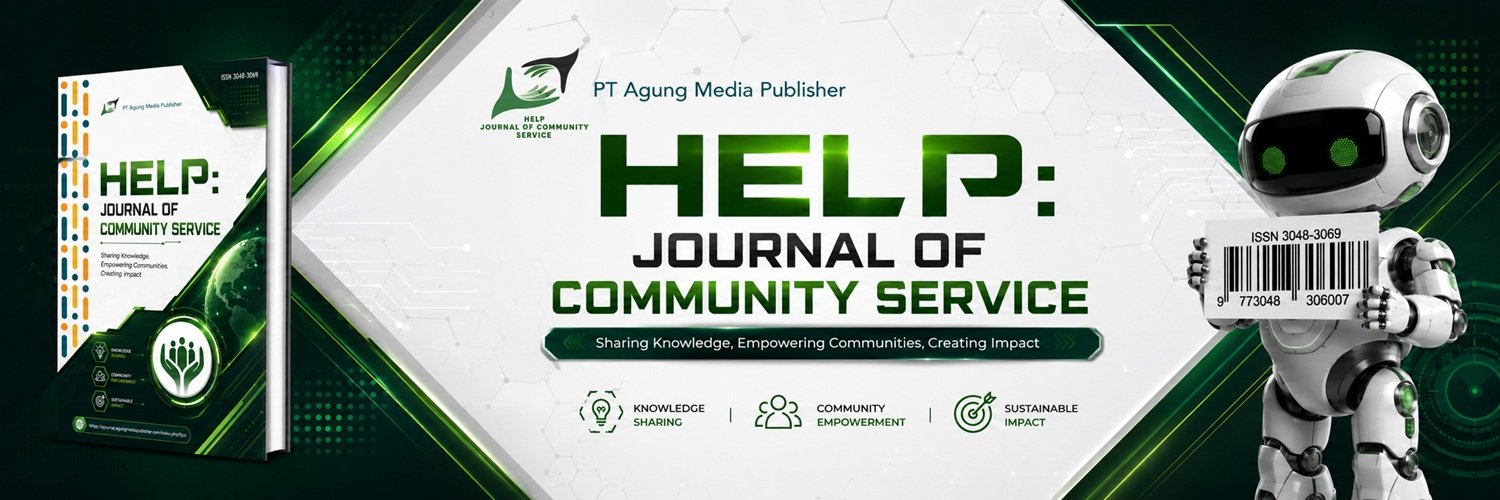
Help: Journal of Community Service (HJCS) is committed to increasing the discoverability, accessibility, visibility, and scholarly impact of its published articles. As a fully open-access multidisciplinary journal, HJCS continuously works to ensure that its articles and metadata are accessible through recognized scholarly information systems, academic search engines, repositories, and indexing services.
HJCS is published with ISSN (Online): 3048-3069 and uses the Digital Object Identifier (DOI): 10.62569/hjcs, providing persistent identification and facilitating the discovery, citation, and long-term accessibility of published articles.
HJCS is currently working to expand its presence in reputable academic databases and indexing services. The journal's published content and metadata may be discoverable through the following scholarly platforms:
HJCS articles are made available online through the journal's Open Journal System (OJS) platform and are intended to be discoverable through Google Scholar, supporting the visibility and citation of published scholarly works.
HJCS uses DOI registration and metadata services through Crossref to provide persistent identification and structured bibliographic metadata for its published articles. Each published article receives a DOI that facilitates citation, linking, and scholarly discovery.
HJCS supports the discoverability and citation tracking of its scholarly publications through scholarly research information systems, including Dimensions, where journal and article metadata are available or indexed.
HJCS also supports broader scholarly discoverability through Scilit, a scholarly database and literature discovery platform that facilitates access to academic publications and bibliographic information.
HJCS maintains structured article metadata through its OJS publishing platform. Published articles include essential bibliographic information such as:
article title;
author names and affiliations;
abstract;
keywords;
publication date;
journal title;
volume and issue;
page numbers;
ISSN;
DOI;
references; and
licensing information.
This metadata supports the discoverability, identification, citation, and interoperability of HJCS publications across scholarly information systems.
Every published article is assigned a persistent DOI whenever it enters the journal's formal publication record. The DOI system enables readers and researchers to locate published articles even when the journal's website structure or web address changes.
For example, published HJCS articles are identified through DOI links such as https://doi.org/10.62569/hjcs.v3i1.279.
HJCS continuously seeks opportunities to improve the international and national visibility of its publications. The journal may apply for inclusion in additional recognized indexing and abstracting services when the journal meets the relevant eligibility requirements.
The journal does not claim inclusion in an indexing service unless such inclusion has been officially confirmed by the relevant indexing organization.
Any new indexing or abstracting service obtained by HJCS will be added to this page with accurate information regarding the status of the journal's inclusion.
HJCS is committed to maintaining accurate and transparent information regarding its indexing status. The journal does not use misleading claims, unofficial indexing badges, or unauthorized logos to imply inclusion in databases where the journal has not been formally accepted.
Indexing status does not influence the editorial evaluation of manuscripts. All submissions continue to be assessed according to the journal's scope, academic quality, originality, methodological rigor, ethical standards, and double-blind peer-review process. HJCS applies a double-blind peer-review process in which submitted manuscripts are evaluated by qualified reviewers.
HJCS recognizes that indexing and abstracting are important components of scholarly communication. Therefore, the journal continuously improves its editorial quality, publication ethics, metadata quality, DOI implementation, digital preservation, publication regularity, and international visibility.
Through these efforts, HJCS aims to become an increasingly discoverable and trusted platform for disseminating knowledge in:
Community Service — Community Engagement — Community Empowerment — Capacity Building — Participatory Action Research — Community-Based Research — Service Learning — Asset-Based Community Development — Multidisciplinary Community Development
Discoverability • Accessibility • Visibility • Interoperability • Scholarly Impact
HJCS is committed to making community-service knowledge easier to discover, access, cite, share, and apply for the benefit of researchers, academics, practitioners, policymakers, institutions, and communities.